FIRST SCI-FI - TRANSFERABLE SKILLS


I’ve just completed my first science fiction book - Nonrecursive (to be published in early 2027). Sci-Fi’s superficially quite a
change after five novels depicting Napoleonic era naval warfare, I think these genres are more related than they appear at first glance. I think that good books – or at least the books I like - have the same ingredients:
Above all else, they have a good plot. Whether it’s about a scheme to kidnap the King of ngland from the esplanade at Weymouth, as imagined in my first novel:

WEYMOUTH BOUND
SPECIAL OFFER 0.99
Weymouth Bound is available as a limited time special offer on Kindle, Kobo and others
Weymouth Bound - Amazon Offer
or first contact with an alien intelligence - as in Nonrecursive - the plot must be interesting, and, for my money at least, be plausible.
Secondly, and this feeds into plausibility, the author should know the subject. Though I’ve never served aboard a sailing man o’war, I have been to sea and I’ve sailed to the places I describe in my novels. Sci-Fi is more unknowable. For example, I've never repaired an interstellar spaceship, but I have worked on seagoing ships, and solved engineering problems, and that gives a good starting point for the imagination. I’ve thought a lot about how an alien civilisation might make contact, and the difficulties of space travel. While wrting Nonrecursive I 'designed' a possible starship powered by fusion engines, and printed a 3D model to assist my thinking.

In other words, I can imagine what it might be like to be in those situations – in Gulf of Lions the young man, given a fearsome weapon of war, taking her into the dark Trieux Estuary, motivated by patriotism, a long tradition of aggression, and the prospect of loot – and in Nonrecursive the older man, an engineer and entrepreneur, making, entirely by chance, the first human contact with an alien civilisation.

First contact - how could the vast distances of interstellar space be traversed? To invent some system of faster than light travel would make things much easier, but to me seems intellectually unsatisfying. It has always seemed to me that it is likely that interstellar exploration would be carried out by machines. To me, the challenges of transporting biological intelligences over the vast timescales involved are, to my imagination at least, insurmountable, and I believe that the first aliens we encounter will be AIs.
I’ve been working on a novel medical device, and have now finished what I hope is a pre-production prototype. I can cope with the mechanical design using 3D CAD and 3D printing, and I can just about wire up the electronics, but the project required quite a bit of software. I have no recent experience of computer programming, and so, inevitably, I turned to ‘vibe coding’. Vibe coding uses AI to write code. I tell the AI what I want, and the AI writes the code. Using the vast database of previously written software, it can write, very quickly, fully functioning scripts. I have almost no idea how to write a Python script, but I can use AI to easily write programs incorporating sophisticated mathematics. Occasionally I have spent an entire day communicating with the AI, and it is sometimes easy to forget that I am not talking to a living person – one that shows no symptoms of boredom or inattention.
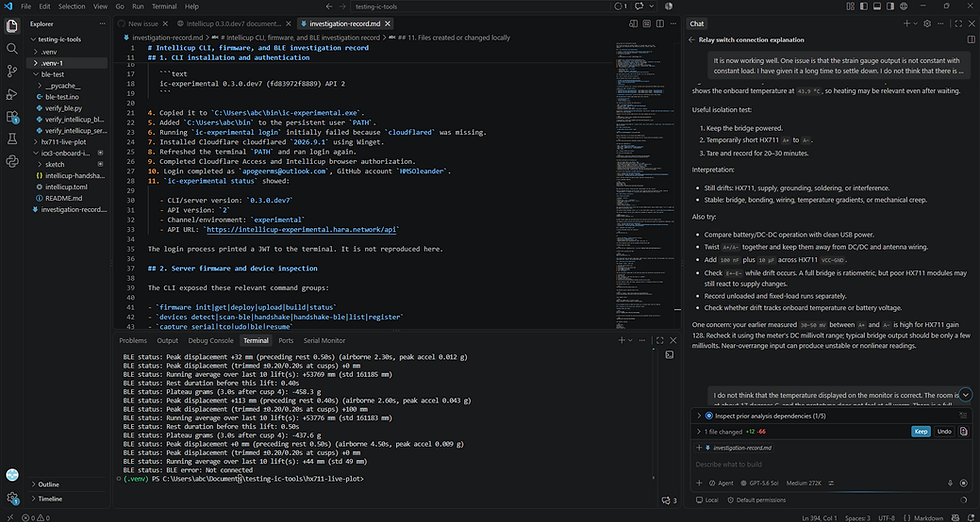
I have used this experience to imagine the alien AI in Nonrecursive. Is it possible for an AI to incorporate the mind of a living being? Would an AI become mentally unstable after long periods of loneliness? How might an alien AI react to humans and human society?
Skills can be transferred, and - given background knowledge - there is not much difference between writing Sci-Fi and naval historical fiction.


Comments